What is the most unusual thing found in the River Thames?
Loaded medieval dice sealed in a lead pot, an ivory sundial reunited after eight years, an Iron Age shield and a shed boa skin: the strangest documented Thames finds and the permit rules behind them.
 By James Whitfield, London river and travel writer
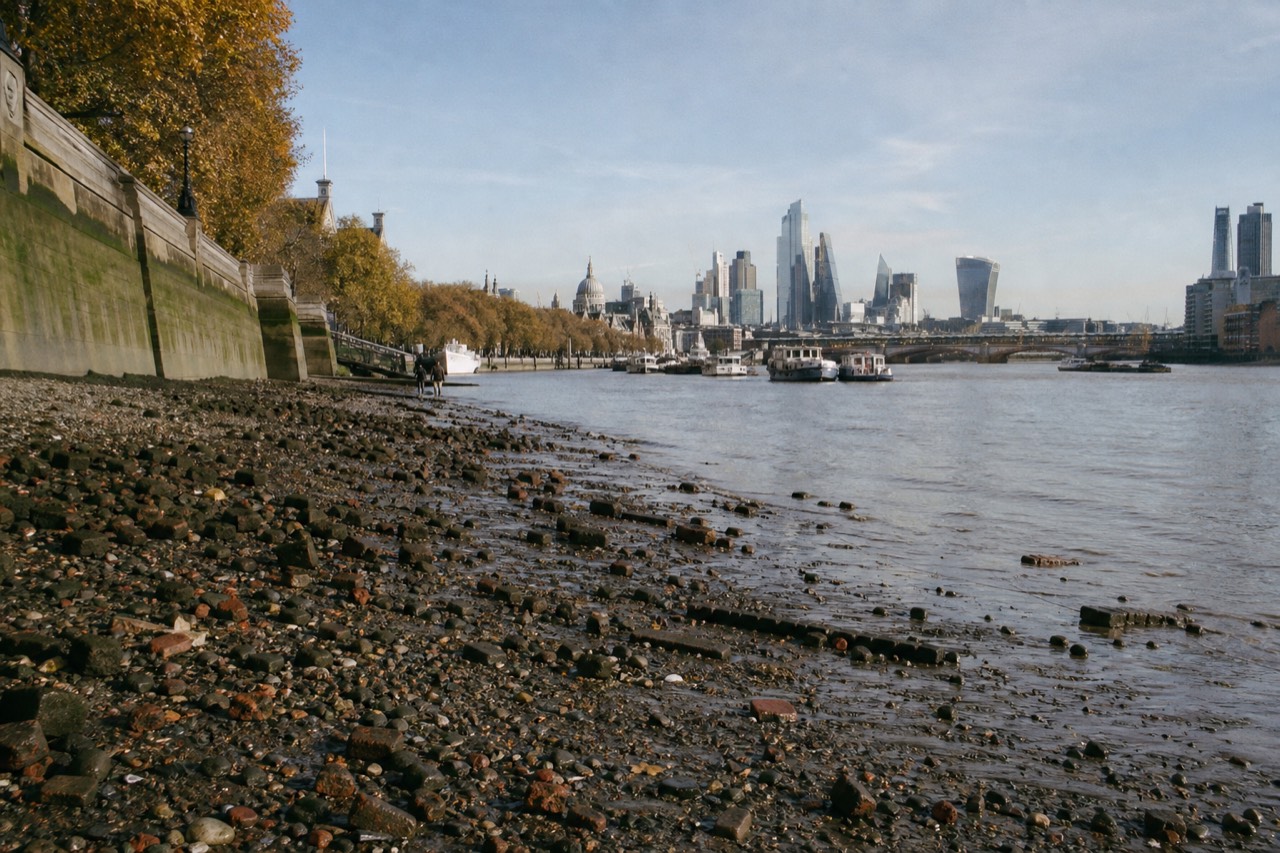
Two halves of a sixteenth-century ivory pocket sundial were found on the Thames foreshore by two different people, roughly eight years apart, and later reunited on the same museum shelf. That is the sort of thing this river does. It is not a lake that quietly keeps what falls in; it is a tidal conveyor that buries objects in oxygen-free mud, shuffles them for centuries and then hands them back twice a day at low water.
I went through the London Museum's own accounts of its foreshore finds, the Port of London Authority's permit rules and the dated news coverage of recent recoveries, and left out everything I could not tie to a named source. Mudlarking generates more folklore than almost any London hobby, so the list below is deliberately short and deliberately checkable.
What is the most unusual thing found in the River Thames?
The strongest documented candidate is a set of 24 tiny bone dice from the late fifteenth century, several of them altered for cheating and some weighted with mercury, recovered from the foreshore inside a lead pot that had been squeezed shut. It is a complete cheat's kit, deliberately disposed of, and it is now in the London Museum.
What makes it the answer rather than merely a good story is how much of a scene it preserves. Somebody in medieval London ran loaded dice, was in enough trouble to want the evidence gone, crushed the pot closed and threw it into the water. Every element of that survived: the dice, the tampering, the container, the intent. Most Thames finds give you an object. This one gives you a moment.
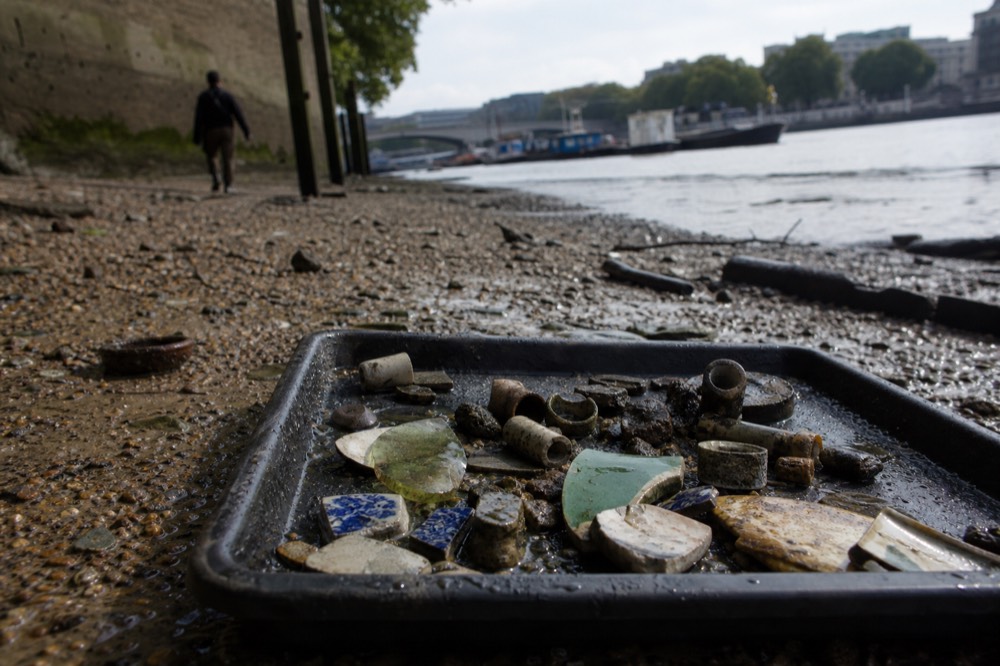
It has competition. The ivory diptych sundial mentioned above, made somewhere around 1550 to 1650 and possibly Nuremberg work, was found in two pieces by two mudlarks, Peter Olivant and Gabriel Schmitt, with about eight years between the recoveries, and both halves ended up displayed together. The odds against that are difficult to picture on a river that moves everything it holds. The London Museum's own account of surprising foreshore finds covers both objects.
Then there is the modern category, which is stranger in a different way. In 2022 the mudlark Jason Sandy picked up the freshly shed skin of a boa constrictor around six feet long, almost certainly from an abandoned pet. The Thames has always been where London puts things it wants to stop thinking about, and that has not changed in five hundred years.
What are the most famous objects pulled out of the Thames?
The Battersea Shield leads by a distance: an Iron Age bronze shield facing decorated in La Tène style with red glass studs, dredged from the river at Battersea in 1857 during bridge works and held by the British Museum ever since. After it come the Bronze Age swords, the Roman intaglios and the prehistoric human skulls.
The shield is the object that changed how archaeologists read the river. Dated to roughly 350 to 50 BC, it was never a practical piece of armour: the bronze facing covered a wooden shield and the workmanship is display quality. Objects like it are now widely understood as deliberate deposits rather than losses, which reframes the whole river as a place where things were given rather than dropped. Its collection record and dating are well established.
The Roman material is the surprise for most people, because it is so small. One stretch of foreshore near the outfall of a former Roman bathhouse culvert has produced more than thirty intaglios, the engraved gemstones that sat in signet rings: green jasper carved with Sol in his chariot, carnelian with Fortuna and her cornucopia. They came out of the drain of a bathhouse, which is exactly where you would expect rings to slip off wet fingers.
| Find | Age of the object | Where on the river | Found | Where it is now |
|---|---|---|---|---|
| Battersea Shield | Iron Age, c. 350 to 50 BC | River at Battersea, near Chelsea Bridge | Dredged 1857 during bridge works | British Museum |
| Bronze Age copper-alloy swords | Bronze Age | West London reaches, clustered findspots | Various, many by mudlarks | London Museum, about 180 blades |
| Roman intaglios | Roman, 1st to 4th century AD | One foreshore area by a bathhouse culvert | Recent mudlark recoveries, 30-plus from one spot | London Museum |
| Ivory diptych pocket sundial | c. 1550 to 1650 | Thames foreshore | Two halves about eight years apart | London Museum, reunited and displayed |
| Set of 24 loaded bone dice | Late 15th century | Thames foreshore, inside a sealed lead pot | Recovered by a permit-holding mudlark | London Museum |
| Prehistoric human crania | Mostly Neolithic and Bronze Age | Concentration around Mortlake, 43 individuals | Historic and modern recoveries | Recorded via the London Museum |
| Doves Press metal type | Lost around 1916 to 1917 | Under Hammersmith Bridge | 41 pieces in one session, September 2025 | With the finder, reported |
| Shed boa constrictor skin | Modern | Thames foreshore | 2022 | Reported, not accessioned |
Why does the Thames give so much back?
Because the mud is anaerobic and the tide is relentless. Objects that sink into Thames silt sit in oxygen-free conditions where metal, leather, bone and wood survive far longer than they would on land, and the twice-daily tide keeps stripping and re-depositing the surface, exposing a different layer every few weeks.
Preservation is the first half. London clay and river silt hold almost no oxygen, which stalls the decay that destroys organic material in normal soil. That is why the river produces leather shoes, wooden objects and bone alongside the metal, and why a fifteenth-century lead pot came up intact enough to still be holding its contents.
The second half is movement, and it is what makes the foreshore unlike any archaeological site on land. A dig removes a layer once. The Thames removes and rebuilds its surface on every tide, so the same patch of shingle can be barren for a season and then produce a Roman gemstone after a storm shifts the gravel. The Doves Press type recovered under Hammersmith Bridge in September 2025 came from a patch that only became reachable after an accumulation of wet wipes was cleared from the bed, and 41 pieces of it came up in a single session, according to the BBC's reporting on the recovery.
There is a darker strand to the same physics. Human remains turn up regularly, most of them prehistoric: over 250 individuals are documented along the London Thames, with a striking concentration of around 43 in the Mortlake area, including a skull of roughly 5,500 years old. Archaeologists debate whether that reflects ritual deposition, erosion of riverside burials, or both. The modern side of the same subject is covered separately in what the river recovers today.
The easiest way to watch that turnover at work is from mid-river on a falling tide, when the exposed edge runs almost continuously along both banks from Westminster down to Greenwich and the barge beds surface one reach at a time. That hour of water is the most-booked sailing in London at £17.20 from, and the live availability on your date is worth a look before a summer morning.
Who is allowed to search the foreshore, and what does it cost?
Nobody without a permit. The Port of London Authority, which owns the bed and foreshore jointly with the Crown Estate, requires a foreshore permit for any searching, metal detecting, beachcombing, scraping or digging between Teddington and the Thames Barrier. A standard annual permit costs £42 including VAT, and the scheme is capped at roughly 4,000 live permits.
The scheme is also, in practice, closed. Demand pushed the waiting list past 10,000 people, and new registrations have been suspended, with batches released only occasionally to those already in the queue. Anyone telling you they went mudlarking last weekend on a whim either holds a permit, joined a guided walk that does not involve searching, or broke the rules.
The restrictions inside the permit are tighter than most people expect. Standard holders may dig to a maximum of 7.5 centimetres and no further; deeper work needs a separate digging permit with mapping, refilling and reporting conditions attached, and is largely limited to Society of Thames Mudlarks members. Mechanical tools are banned outright. Scheduled and protected areas, Queenhithe Dock among them, are off limits entirely. And a permit is not a licence to sell: disposing of finds requires the PLA's permission.
| Permit rule | The detail |
|---|---|
| Standard annual permit | £42 including VAT, valid one year from issue |
| Creative permit, for non-historic finds used in art | £104 |
| Scheme cap | Around 4,000 live permits at any time |
| Waiting list | Passed 10,000; new registrations suspended |
| Geographic limit | Teddington to the Thames Barrier only, not east of the Barrier |
| Minimum age | 12, and every searcher needs their own permit |
| Digging depth, standard permit | 7.5 cm maximum, no mechanical tools |
| Deeper digging | Separate permit, roughly 0.6 m, up to 1.3 m in the City of London |
| Selling finds | Requires PLA permission |
The current fees, zones and conditions live on the PLA's foreshore permits page, and they change: the fee schedule is reissued annually, so treat any figure you read elsewhere as a starting point rather than the number you will pay.
What must a finder report, and to whom?
Three separate obligations. Any object more than 300 years old goes to the London Museum's Finds Liaison Officer for recording under the Portable Antiquities Scheme. Anything meeting the Treasure Act definition goes to the coroner within 14 days. Human remains go to the police and the museum, immediately.
The recording obligation is the one that turns a hobby into archaeology. A find on its own is a curiosity; a find with a recorded location, date and description becomes evidence, and the Portable Antiquities Scheme database now holds more than 14,000 historical records from Thames foreshore mudlarks, part of a national total above 1.8 million objects.
Treasure is a narrower legal category than the word suggests. It covers gold and silver objects over 300 years old that meet set criteria, hoards, and certain exceptional finds, and the duty is to report to the local coroner rather than to a museum. Greater London produces very few cases by rural standards: eight provisional treasure finds in 2024, down from fourteen the year before, with mudlarking accounting for well under one per cent of the national total.
Human remains are the third and most serious category, and the rule is absolute. They go to the police first. Given how many prehistoric skulls the river has produced, a foreshore find of bone is more likely to be Neolithic than recent, but that is not a judgement for the finder to make on the shingle.
How much is actually found in a year?
More than the headlines suggest and less than the folklore claims. The London Museum's Finds Liaison Officer records around 700 significant Thames foreshore finds a year and identifies roughly 5,000 objects annually, of which only a small number are acquired for the collection.
Those two figures tell you the real shape of mudlarking. Most of what comes off the foreshore is identified, logged and handed straight back to the finder, because it is ordinary: clay pipe stems, pins, buttons, pottery, coal-fired industrial debris. The museum wants the record more than the object.
Volume has built up over decades through donations of exactly that ordinary material. One collector, Tony Pilson, donated 2,444 items. Earlier collaborations with the Society of Thames Mudlarks produced tens of thousands of records, and the museum's medieval pilgrim and secular badge holdings, its post-medieval pewter toys and much of its button collection came off the foreshore rather than out of a dig.
The distribution is heavily lopsided, which is why the spectacular finds get the attention. Out of thousands of objects a year, a handful reach exhibition. The Secrets of the Thames exhibition that ran from April 2025 to March 2026 was built largely on mudlark finds, and it took the museum decades of that steady recording to assemble.
What are the rules and the risks on the foreshore itself?
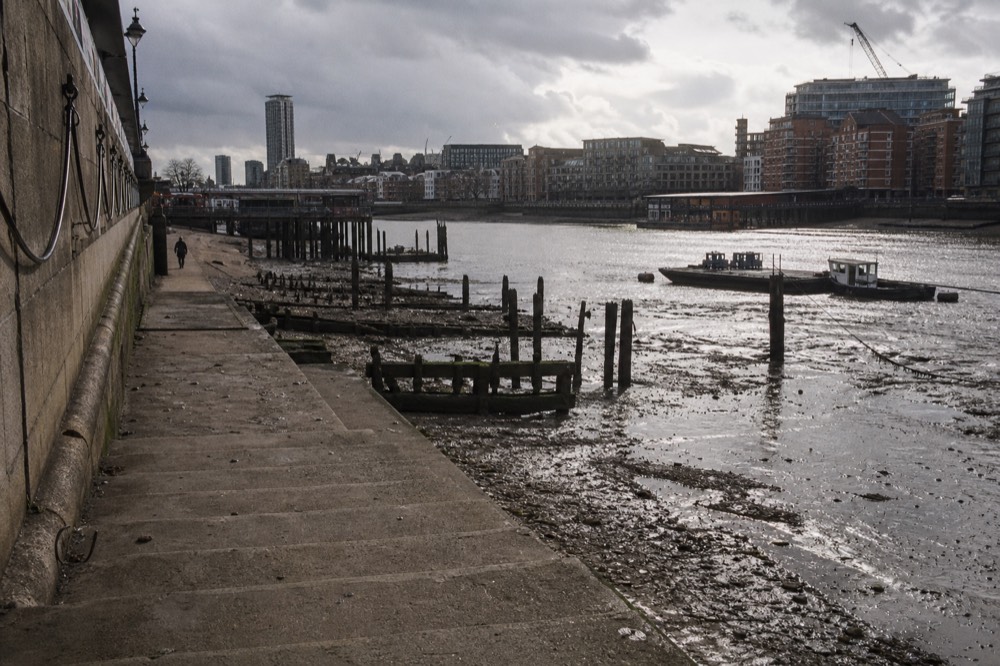
The PLA's line is that the foreshore is not a pleasure beach. Entering or paddling in the water is forbidden, as is disturbing fixed structures or digging in restricted areas. The published hazards are fast currents, cold and deep water, boat wash, slippery access stairs and untreated sewage after heavy rain.
Tide timing is the whole safety plan. The window on any given patch is a few hours, the water comes back faster than people expect on a rising spring tide, and the way out is usually a single set of steep, weed-covered stairs a long way from where you have wandered. The PLA's advice is to work out the exit before going down and to assume you may need it earlier than planned.
| On the foreshore | What the rules say |
|---|---|
| Entering or paddling in the water | Forbidden under the permit conditions |
| Disturbing fixed structures | Forbidden, including timber piles and river stairs |
| Digging in scheduled or restricted areas | Forbidden; Queenhithe Dock among the protected sites |
| Mechanical tools | Not permitted at all |
| Footwear | Strong footwear required; glass, metal and timber underfoot |
| Tide planning | Work out the exit before descending; the window closes fast |
| Passing vessels | Wash arrives without warning on exposed foreshore |
| Water quality | Untreated flows possible after heavy rain |
| Ownership | Bed and foreshore held by the PLA and the Crown Estate to the mean high water mark |
Boat wash is the hazard nobody anticipates. A passing vessel sends a set of waves across an exposed foreshore that can knock a crouching person over and soak equipment, and on the central reaches that happens every few minutes all day. Strong footwear is not a suggestion. Broken glass, corroded metal and submerged timber are everywhere in the mud.
Two more things follow from the ownership. Because the foreshore belongs to the PLA and the Crown Estate up to the mean high water mark, everything on it belongs to them until a permit says otherwise, and because parts of it are scheduled monuments, the ground itself is protected. The permit conditions are the mechanism that lets the public search a legally protected riverbed at all.
How does the tide that uncovers the foreshore shape a boat trip?
The same twice-daily tide that exposes the mudlarking ground sets what you see from the water. At low water the foreshore, barge beds and Victorian timber piles are visible along both banks; at high water they are gone. Fast boats running east to the Thames Barrier cover more of that changing edge than any sightseeing sailing.
It is worth watching for on any trip downstream. On a falling tide the walls grow, the stairs appear, and the ribs of old lighters and jetty piles surface along the reaches between Wapping and Greenwich. Two hours later the same banks are blank stone. Nothing else on a London itinerary changes that visibly between morning and afternoon.
The fast boats show you the most of it, because they go furthest. A 70-minute RIB from Embankment or Westminster runs the full working river out to the Thames Barrier and back, past the wharves, the flood defences and the stretch where the foreshore widens as the river does, at £75.48 from. The shorter 20-minute blast from Tower Pier at £37.74 covers the central bend instead. Both are laid out in the RIB and speedboat comparison, and it is worth checking the live dates for the Barrier run because the boats hold twelve and sell out.
If you want time rather than speed, the slow version reads the banks better. An hour from Westminster to Greenwich at £17.20 gives you the whole north bank at walking pace, with long enough at each reach to pick out the timber. Every sailing on the river is compared side by side on Thames River Cruises, and the full ranking sits in the best cruise guide.
The other useful pairing is a low-tide walk with a high-tide sail. Check the day's times, take the hop-on hop-off river pass if you want to break the day at Greenwich or the Tower, and you get both versions of the same river. Some of the strangest details of that river are collected in five facts about the Thames, and the longer story of how it became so heavily loaded with objects is in why the Thames is so famous.
Common questions
Can anyone go mudlarking on the Thames?
No. A Port of London Authority foreshore permit is required for any searching, metal detecting, beachcombing, scraping or digging between Teddington and the Thames Barrier, and the scheme is capped at around 4,000 live permits with new registrations suspended after the waiting list passed 10,000. The minimum age is 12 and every searcher needs their own permit, though a companion may watch without one.What is the oldest thing found in the River Thames?
Prehistoric human remains and Bronze Age metalwork compete for the title. Over 250 individuals are documented along the London Thames, including a Neolithic skull of roughly 5,500 years old, and the London Museum holds around 180 Bronze Age copper-alloy blades from the river. The Battersea Shield, at roughly 2,000 to 2,400 years old, is the most famous rather than the oldest.Do you get to keep what you find in the Thames?
Usually, but not automatically. Objects over 300 years old must be recorded with the London Museum's Finds Liaison Officer, treasure as defined by the Treasure Act must be reported to the coroner within 14 days, and human remains go to the police. The foreshore belongs to the PLA and the Crown Estate, and selling a find requires the PLA's permission.Where is the best place to see the Thames foreshore?
Any set of river stairs at low water on the central reaches, with the tide table checked first. From the water you see more of it at once: a boat running downstream on a falling tide passes exposed barge beds, timber piles and the widening foreshore below the embankment walls all the way to Greenwich, which no single walk delivers in an hour.Why do so many objects end up in the Thames?
Two thousand years of a city using the river as its main road, its port, its rubbish tip and, in prehistory, a place of deliberate offering. Anaerobic silt then preserves what a normal soil would destroy, and the tide re-exposes the surface twice a day, so the river keeps handing material back rather than burying it permanently.So the honest answer to the question is a set of loaded dice in a crushed lead pot, with an ivory sundial found in two halves eight years apart running a close second. Both are more interesting than the giant, vague objects the question usually attracts, and both are on a museum shelf where you can go and look at them. The river that produced them is still working, still tidal, and still handing things back every twelve hours.